
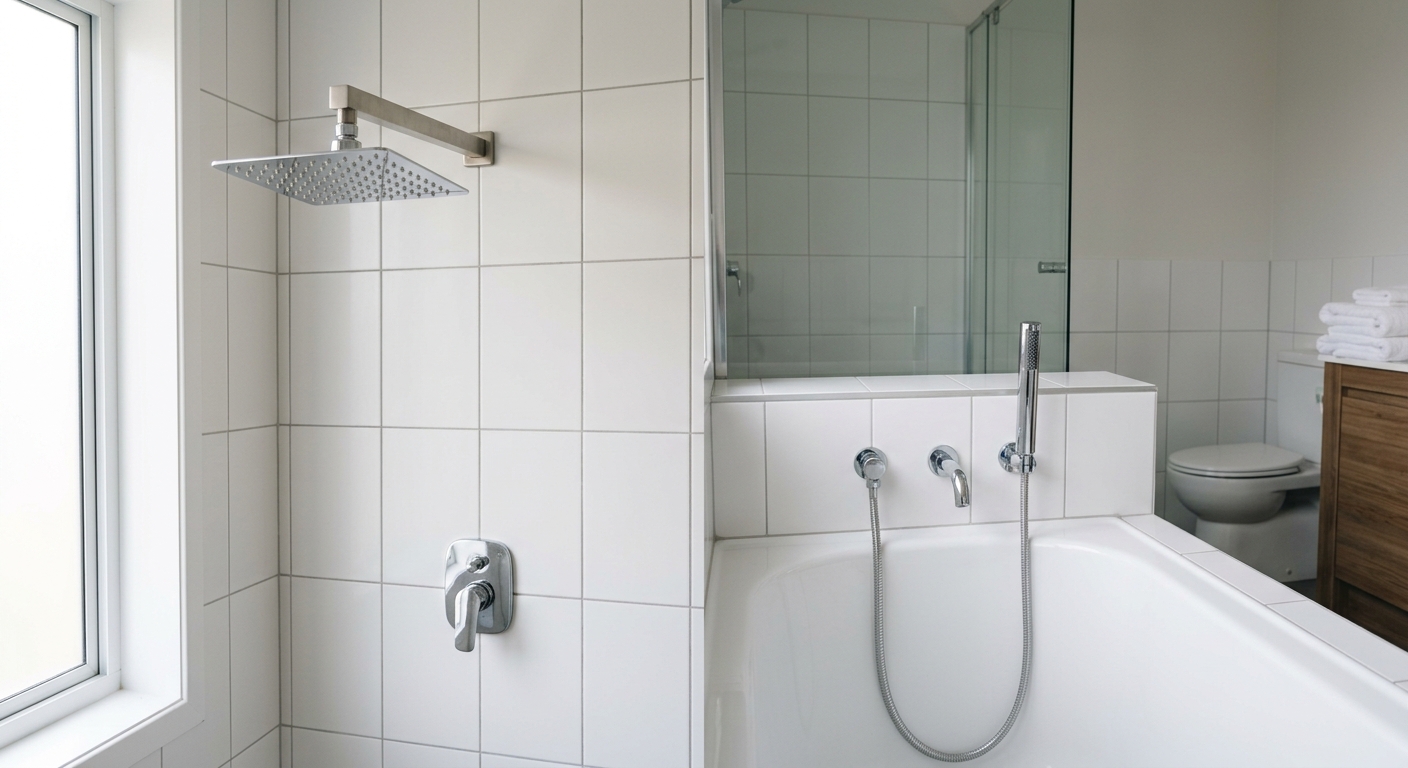
Wall-mounted shower arms win on flow consistency and repair access; deck-mounted tub-shower combos win on retrofit cost in rooms that already have a tub spout rough-in. The right call depends on whether you’re building new, gut-renovating, or doing a fixture swap in an occupied tower, and on how much labor cost you’re willing to absorb over a 10 to 15 year fixture life.
Deck-Mounted Combos: Tub-Shower Tradeoffs
Deck-mounted tub-shower combos route water through a single valve body set in the tub deck or wall, then split it between the tub spout and the shower head via a diverter. This is standard in extended-stay and midscale properties where tubs are still expected by a meaningful share of guests. The upside is a simpler rough-in: one valve, one supply stub, no separate shower arm penetration through tile.
The downside shows up in flow performance. Diverter valves are a mechanical compromise, not a dedicated shower valve, and they lose pressure every time water changes direction through the diverter gate. On an aging diverter, you’ll see guests cranking the handle to compensate, which increases actual draw per shower even if the head itself is rated efficiently.
Wall-Mounted Arms: Flow Calibration Control
Wall-mounted shower arms thread onto a dedicated shower valve with no diverter in the path. The arm itself is a standard 1/2-inch NPT connection, which means replacement heads, flow restrictors, and arm extensions are commodity parts you can source from almost any plumbing supplier without matching a proprietary deck-valve kit. For walk-in showers and shower-only rooms (common in upper-midscale and select-service builds), this is now the default spec.
Because there’s no diverter bleeding off pressure, a wall-mounted head delivers closer to its rated flow at the point of use. That matters for GPM compliance: a head rated at 1.75 GPM under WaterSense testing should deliver close to that number at typical hotel supply pressure (usually 40 to 60 psi at the fixture). A deck-mounted combo with a tired diverter can show a measurable gap between rated and actual flow, which complicates any sustainability reporting that assumes nameplate GPM.
Diverter Valves and GPM Loss
This is the part most procurement comparisons skip. Federal law caps shower heads at 2.5 GPM; WaterSense-labeled heads are independently tested to 1.75 GPM or less at 80 psi. Those numbers describe the head in isolation, on a test rig, not the head as installed behind a diverter that’s been in service for eight years.
In a deck-mounted combo, the diverter gate has to fully seat to send water up to the head. Mineral buildup, worn gaskets, or a weak spring mechanism let water bypass to the tub spout even when the diverter is engaged, which shows up as low pressure at the head and wasted flow out the spout. You won’t catch this on a spec sheet. You catch it on a flow-test walkthrough or when guest complaints about weak pressure cluster in rooms with older combo valves.
- Wall-mounted dedicated valve: no diverter loss, flow stays close to rated GPM for the life of the cartridge.
- Deck-mounted combo, new diverter: minor loss, typically within normal cartridge tolerance.
- Deck-mounted combo, diverter past 5 to 7 years of guest-cycle use: loss becomes noticeable and inconsistent room to room.
Maintenance Access: Slab vs Wall Cavity
Access is where lifecycle cost actually gets decided, and it’s the part that gets left out of most comparisons built around bathroom looks. Deck-mounted valves in a tub are often set low, sometimes behind a tile apron or even partially in a slab pour on ground-floor and podium-level rooms. Replacing a cartridge or diverter in that condition can mean cutting access, which is a different labor category and a different cost than a straightforward parts swap.
Wall-mounted valves are set inside a stud or metal-frame wall cavity, almost always with an access panel on the opposite side (often in the adjoining closet or corridor chase in hotel construction). A tech pulls the panel, swaps the cartridge, and closes it back up. No tile work, no guest room downtime beyond the repair window itself. If your engineering team is tracking average repair time per work order, wall-mounted valves should show up meaningfully faster across a renovation cycle.
| Factor | Deck-Mounted Combo | Wall-Mounted Arm |
|---|---|---|
| Valve access | Tub deck or slab, often requires tile cut | Wall cavity, access panel standard |
| Flow consistency | Degrades as diverter wears | Stable over cartridge life |
| Parts sourcing | Often matched to specific valve body | Commodity 1/2-inch NPT parts |
| Best fit | Tub-shower combo rooms | Walk-in shower rooms |
Retrofit and Install Cost Per Room
New construction removes most of the argument: spec wall-mounted valves for walk-in showers and accept deck-mounted combos only where a tub is programmatically required. The harder decision is retrofit in an occupied or soft-renovation property.
Swapping a deck-mounted tub spout and diverter for a new unit of the same type is usually a same-day, same-trade job if the valve body itself is sound and you’re only replacing the trim kit. Converting an existing tub-shower combo to a dedicated wall-mounted valve means opening the wall, running new supply to a different point, and patching tile or surround, which is renovation-scope work, not routine maintenance. Budget it as a capital project line, not an operating repair.
If you’re already running capital projects across food and beverage and guest room plumbing in the same renovation cycle, it’s worth coordinating supplier relationships rather than treating each category in isolation. Hotels that are resourcing commercial kitchen faucets for a back-of-house refresh at the same time as guest bathroom work can often consolidate vendor negotiations, since both categories are driven by duty-cycle durability rather than finish aesthetics.
Which Wins by Room Tier
Select-service and extended-stay tiers with walk-in-only showers should default to wall-mounted arms. The access and flow-consistency advantages compound over a multi-year hold, and the parts are cheaper to keep in inventory.
Full-service and upper-upscale properties with tub-shower combos in a meaningful share of rooms don’t have a clean choice. A deck-mounted combo keeps construction cost down and preserves the tub amenity, but procurement should budget for diverter replacement on a defined cycle (commonly 5 to 7 years depending on water hardness) rather than waiting for complaint-driven repairs.
- Confirm which rooms have tubs versus walk-in showers before specifying a single standard across the property.
- Check whether existing deck-mounted valve bodies are proprietary before planning a trim-only refresh.
- Flow-test a sample of combo rooms against nameplate GPM before assuming your WaterSense specification is holding in the field.
- Confirm wall cavity access panels are specified in any new-build walk-in shower layout, not left to the GC’s default framing.
Before finalizing a spec, walk a representative floor with facilities engineering and confirm access conditions room by room. A plumbing contractor who’s worked your building type can tell you in an hour whether a wall-cavity retrofit is realistic or whether you’re better off holding the line on deck-mounted combos until the next full renovation.